Search This Blog

Monday, January 18, 2010

Sony Ericsson Satio U1i camera 'among the best'

                                           Sony Ericsson's Satio U1i has a camera "among the best you can get", according to Trusted Reviews. The 12.1-megapixel camera with Xenon flash "marks itself out from the crowd" by being "very quick in operation".

It takes two seconds to start up and can take three pictures every ten seconds, according to the review.

The touchscreen handset has a 3.5-inch 360 x 640 pixel screen for "great multimedia viewing" and the website notes that the screen has enough browsing space to feel that surfing the internet is not "like too much of a chore".
A multimedia interface makes browsing through media files "easy and looks quite pretty", and taking photos is made easy by the "very good" viewing angles.
The phone has a solid slide mechanism to avoid being accidentally opened and uses a Symbian S60 operating system.
Trusted Reviews added that Sony Ericsson make a "decent effort" with implementation by having a facility to sift through five desktops, rather than just having one as standard.
Sony Ericsson has been around since October 2001 and claims it inspires people to "do more than just communicate".
The Sony Ericsson Satio handset is available in black and silver.

Sunday, January 17, 2010

Graphics Evolves Beyond Gaming With New NVIDIA Geforce GTX 200 GPUs


PNY VCGGTX295SXPB
SANTA CLARA, CA—JUNE 16, 2008—Imagine instead of taking over five hours to convert a video for your iPod, it only takes 35 minutesi. Imagine using your PC to simulate protein folding to help find a cure for debilitating diseases. Imagine that your PC can dramatically accelerate everyday tasks, and deliver an exciting visual experience in the process. Today that imagination becomes a reality now that the leader in visual computing technologies, NVIDIA (Nasdaq: NVDA), has introduced its new family of GeForce® GTX 200 graphics processors (GPUs)—which includes the GeForce GTX 280 and GeForce GTX 260 GPUs—taking graphics beyond gaming and gaming beyond anything that’s ever been possible before on a consumer computing platform.
“The advances NVIDIA continues to make in visual computing are simply incredible, and we are excited to be one of the first companies in the world to offer the technology in the new Exhilaration Edition of the award-winning HP Blackbird 002,” said Rahul Sood, chief technology officer, HP Voodoo Business Unit. “Exceptional graphics quality and performance is important to our customers, and now the GeForce GTX 200 GPUs are bringing something else into the mix. By using the GPU to enhance everyday applications such as video encoding and manipulating photos, HP Blackbird 002 is one of the most cutting-edge PC platforms ever designed.”
Graphics Beyond Gaming
One of the most powerful processors in the PC is the GPU. Rendering 3D images in real-time is just about the most mathematically intensive task your PC will ever undertake, but it’s not the only one. As PC applications become increasingly visual, many ordinary tasks will benefit from the graphics horsepower provided by the GPU, including encoding and playing high-definition videos, editing photos, getting driving directions off the Internet, or simply running a new operating system like Windows Vista.
“Millions of users around the world know how time consuming it is to convert their home videos for use on video sharing sites such as YouTube or for downloading to popular media players such as the iPod,” said Sam Blackman, CEO of Elemental Technologies. “Elemental has developed the BadaBOOM™ Media Converter, a consumer video application scheduled for release in August. By taking advantage of the massively parallel, general-purpose computing architecture of a GeForce GPU, we are able to transcode high-quality video 18 times faster than with CPU-only implementations. This unprecedented performance scaling is the reason why we have made sure that our RapiHDTM Video Platform takes advantage of NVIDIA GPUs.”
By recognizing that the value of a GPU transcends gaming, an increasing number of applications are also being written that use the GPU for straight, non-graphical computational tasks. For example, Stanford University’s distributed computing computational program Folding@Home, combines the computing horsepower of millions of consumer GPUs to simulate protein folding to help find cures for diseases such as Alzheimer’s or Parkinson’s. With the computing processing power of the GeForce GTX family, applications such as Folding@Home and others can run upwards of 140 times faster on an NVIDIA general-purpose parallel processor than on some of today’s traditional CPUs.
“GeForce GPUs will soon deliver the biggest boost in processing power we’ve seen in the history of Folding@Home,” said Vijay Pande, Associate Professor of Chemistry, Stanford University. “The GeForce GTX 280 GPU runs Folding@Home 45 times faster than the latest 3GHz Core2 Quad CPU. If just one percent of the world’s GeForce 8- and 9-Series GPUs ran Folding@Home, we would have 70 petaflops of processing power to help find cures for disease. That’s 10 times more processing power than the world’s top 100 supercomputers combined.”

Saturday, January 9, 2010

Google wants to buy, sell electricity in US

http://images.ibox.bg/2007/05/04/tec%20marica%20iztok%202/519x426.jpg
Internet search giant Google is seeking government authority to buy and sell electricity in the United States, a further expansion of its operations aimed at boosting renewable energy.

In a document filed last month with the Federal Energy Regulatory Commission and obtained by AFP, Google indicated that its Google Energy unit asked for "market-based rate authority."

Under that authority, "Google Energy will engage in wholesale electric power and energy transactions as a marketer," the filing said.

The move marked an additional step by the California-based Internet giant to reduce its carbon footprint.

http://www.frostgreenchoice.com/Portals/0/Images/Alternative/solar_panels.jpg

Google announced in 2007 that it would invest in renewable energy. It has already launched a free software, PowerMeter, that allows individuals and businesses to monitor their energy consumption.

The company in mid-December pledged on its blog "Going green at Google" that it was going to make its operations carbon-neutral and reduce greenhouse gases blamed for global warming.

Niki Fenwick, a Google spokeswoman, told specialist website CNET that the company wanted to become a player on the power grid.

"Right now, we can't buy affordable, utility-scale, renewable energy in our markets," Fenwick said.

"We want to buy the highest quality, most affordable renewable energy wherever we can and use the green credits," she said.

"We don't have any concrete plans. We want the ability to buy and sell electricity in case it becomes part of our portfolio."

Wednesday, January 6, 2010

Intel Unveils Details on Arrandale and Clarkdale Processors


All eyes will be on Las Vegas later this week when the 2010 International Consumer Electronics Show (CES) kicks off, but major vendors seem anxious to one-up each other with early announcements preceding the event. Lenovo unveiled its new line of AMD-powered laptops, and Intel has released details of its latest Arrandale and Clarkdale processors.


Both the Arrandale and Clarkdale processors are based on Intel's new Westmere architecture. The array of Arrandale and Clarkdale processors is staggering. The chips come in dual-core Corei7, Corei5, and Corei3 models, which are then further diversified by clock speed and operating voltage.

The Clarkdale chips are aimed at desktop systems, while the Arrandales are targeted for mobile computers. The processors are designed around Intel's new architecture which incorporates graphics processing and memory controller functions into the CPU. This eliminates the need for a separate graphics processor, as well as the Northbridge component of traditional Intel motherboard chipsets.

Like the recently unveiled Atom processors built on the Pinetrail architecture, the Arrandale chips will enable OEM hardware vendors to build smaller mobile computers that consume less power and require less cooling than current mainstream notebooks.

The Arrandale processors improve performance by including a "Dynamic Frequency" feature that allows the processor to vary the clock speed of the GPU function as well as the CPU. For scenarios where you might be watching a Blu-ray disc or watching something in HD, the Arrandale processor can dynamically adjust resources in favor of the graphics processing function to optimize performance.

Intel has also upped the ante on mobile entertainment by including native Blu-ray dual-stream support as well as lossless 7.1 channel audio. The combination may not meet the needs of hardcore HD or audio enthusiasts, but should more than suffice for the needs of mainstream consumers.

Intel unveiled details of new Arrandale and Clarkdale processors

Intel has already been producing and shipping these chips to OEM hardware vendors, so we can probably expect to see a wave of associated desktop and notebook product launches over the next week in conjunction with the 2010 CES event in Las Vegas.

Intel President Paul Ottelini is slated to present a keynote speech at the 2010 CES later this week. Now that the details have already been leaked on the Arrandale and Clarkdale processors, it will be interesting to see if that takes the wind out of Ottelini's sails, or if there are additional surprises up Intel's sleeve.

Monday, January 4, 2010

The future of brain-controlled devices

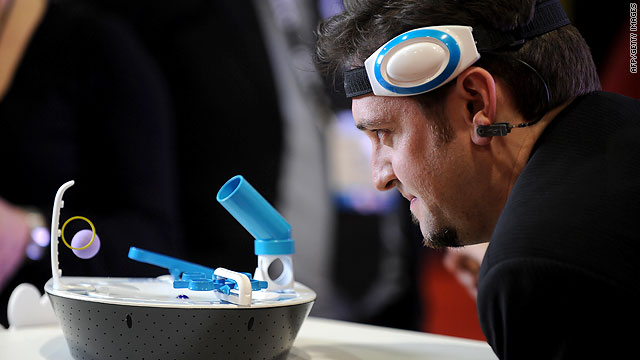
Games such as Mindflex use headsets with simple electrodes to monitor levels of concentration and relaxation.
Games such as Mindflex use headsets with simple electrodes to monitor levels of concentration and relaxation

In the shimmering fantasy realm of the hit movie "Avatar," a paraplegic Marine leaves his wheelchair behind and finds his feet in a new virtual world thanks to "the link," a sophisticated chamber that connects his brain to a surrogate alien, via computer.

This type of interface is a classic tool in gee-whiz science fiction. But the hard science behind it is even more wow-inducing.

Researchers are already using brain-computer interfaces to aid the disabled, treat diseases like Parkinson's and Alzheimer's, and provide therapy for depression and post-traumatic stress disorder. Work is under way on devices that may eventually let you communicate with friends telepathically, give you superhuman hearing and vision or even let you download data directly into your brain, a la "The Matrix."

Researchers are practically giddy over the prospects. "We don't know what the limits are yet," says Melody Moore Jackson, director of Georgia Tech University's BrainLab.

Adds Emory University neuroscience professor Michael Crutcher, "Anything can happen."

At the root of all this technology is the 3-pound generator we all carry in our head. It produces electricity at the microvolt level. But the signals are strong enough to move robots, wheelchairs and prosthetic limbs -- with the help of an external processor.

Harnessing that power "opens up a whole new paradigm for us as human beings," says neuroscientist Rajesh Rao of the University of Washington.

Brain-computer interfaces (BCI) come in two varieties. Noninvasive techniques use electrodes placed on the scalp to measure electrical activity. Invasive procedures implant electrodes directly into the brain. In both cases, the devices interact with a computer to produce a wide variety of applications, ranging from medical breakthroughs and military-tech advances to futuristic video games and toys.

Much of the research focuses on neuroprosthetics, which offer a way for the brain to compensate for injuries and illness. Jackson helped develop an intelligent wheelchair called the Aware Chair, which can be guided by neural activity.

She is also working on communication programs for people who have been paralyzed by strokes or spinal-cord injuries. Implanted electrodes allow "locked in" patients to spell out messages by manipulating a computer cursor with their thoughts alone.

Rao is tapping into that same concept to help paralyzed people manipulate robots to fetch items or move things around the house. With cameras to provide visual feedback, the patients and robots don't even need to be in the same room, or the same city. Rao says the technology "frees the mind from the constraints of the body."

Cochlear implants are the most common neuroprosthetic. They help the brain interpret sounds and are sometimes called "bionic ears" for the deaf. Other researchers are looking for similar ways to help blind people see. Neurobiologist Ed Boyden of MIT says miniature optical devices can be implanted to convert photoreceptors into workable cameras for the brain.

None of this comes cheap. Most research is funded by deep pockets such as the National Institutes of Health, the defense department and NASA.

But every breakthrough brings the most advanced BCI technologies closer to the mass market. Jackson says she foresees a day when people with disabilities can spend a few hundred dollars instead of $20,000 on a workable system.

Mainstreaming the technology raises some troubling issues for Crutcher, who teaches a course at Emory in neuro-ethics. He fears that expensive eye and ear implants could produce a computer-enhanced elite.

"If only the rich can afford it, it puts everyone else at a disadvantage," says Crutcher, who believes many aspects of BCI are ripe for abuse. Just the idea of mucking about with a person's brain "raises questions about safety and efficacy," he says.

One of the more controversial uses under development is telepathy. It would require at least two people to be implanted with electrodes that send and receive signals back and forth.

DARPA, the Pentagon's technology research division, is currently working on an initiative called "Silent Talk," which would let soldiers on secret missions communicate with their thoughts alone. This stealth component is attractive, but naysayers fear that such soldiers could become manipulated for evil means.

Telepathy implants won't replace Facebook and Twitter anytime soon, but that possibility is problematic as well.

"You can imagine communicating with your friends through the devices, and that opens up a lot of ethical issues," Rao says. Would you want your friends and family to know everything you are thinking? Would little white lies become obsolete?

These questions of morality and liability are not a huge factor for the toy makers and video game developers who are already bringing the most basic BCI technology to consumers.

Games like Mindflex and the Star Wars Force Trainer use headsets with simple electrodes to monitor levels of concentration and relaxation. The signals trigger a fan that can move a ball up or down, depending on how hard you're thinking. Jackson calls it a "fascinating application of a very sophisticated technology in a very cheap package."

The headsets used in both games were designed by the California company Neurosky. Its corporate partners are working on games that help Alzheimer's patients improve memory techniques, teach concentration skills to kids with ADHD and let stressed- out CEOs work on relaxing.

Software entrepreneurs and executives are streaming into Boyden's neuro-ventures class at MIT, looking for ways to capitalize on the array of potential uses for brain-computer interfaces.

Some ventures are already up and running. NeuroVigil in California is working on iBrain, designed, in part, to help provide instant feedback to drivers who start falling asleep at the wheel. Eos Neuroscience is developing light-sensitive protein-based sensors that can treat blindness.

Numerous companies are developing video games based on direct brain-computer interfacing. Neurosky sells a wireless headset that connects to any computer for a series of brain-training games. NeuroBoy lets you set targets on fire just by concentrating on them. Relax, and your character levitates. Another application lets you see a colorful visualization of your brain-wave activity.

Boyden expects to see many more such products hitting shelves sooner rather than later. He says the possibilities are endless if just a "fraction of the business leaders" taking his class start "bringing the technology into the world."

Sunday, January 3, 2010

Avatar Review: James Cameron's World of Wonder


Actors Sam Worthington (L) as Jake Sully and Zoe Saldana as ...

In the last shot of Avatar, someone's closed eyes snap open. That's the climax and the message of James Cameron's first fiction feature since 1997s Titanic: Look around! Embrace the movie - surely the most vivid and persuasive creation of a fantasy world ever seen in the history of moving pictures - as a total sensory, sensuous, sensual experience. The planet Pandora that Cameron and his army of artist-technicians have created - at a budget believed to be in excess of $300 million - is a wonder world of flora and fauna: a rainforest (where it never rains) of gigantic trees and phosphorescent plants, of six-legged flying horses, panther dogs and hammerhead dinosaurs. Living among these creatures is Pandora's humanish tribe, the Na'vi: a lean, 10-ft.-tall, blue-striped people with green eyes, or what mankind might have been if it had evolved in harmony with, not opposition to, the edenic environment that gave rise to its birth.

It's the year 2154, and Pandora, a moon of the Alpha Centauri star, is the reluctant host to an expedition of Americans seeking to mine an incredibly valuable rock called unobtainium - a joke term, coined in the 1950s referring to any kind of material that's unavailable or impractical to use, that Cameron employs to locate his movie among science-fiction adventures of the period. The expedition, headed by sleazy entrepreneur Parker Selfridge (Giovanni Ribisi), contains scientists, working for Dr. Grace Augustine (Sigourney Weaver), and a Blackwater-type security force led by the malevolently macho Col. Miles Quaritch (Stephen Lang). The scientists have hatched "avatars," which look like Na'vi but blend their DNA with that of humans, who will steer them by remote control; "dreamwalkers," they're known as. Grace is entranced by the Na'vi's aristocratic gentility, but to Selfridge and Quaritch they are "blue monkeys", "savages," "an aboriginal horde." Or for want of a better word: Disposable. (See the top 10 movies of 2009.)

The new guy in this program is Jake Sully (Sam Worthington, last seen going up against machinery in Terminator Salvation), a paraplegic ex-Marine whose dead identical twin brother had been in the project. Since Jake has the same DNA, he's chosen to man his late brother's avatar. Grace wants Jake to befriend the Na'vi and help her unearth precious biological samples; Quaritch orders him to become a secret spy, as part of the company's plan to drive the tribe away from a sacred tree, under which can be found vast reserves of unobtainium. In this double role, Jake meets Neyfiri (Zoe Saldana), daughter of the tribal chief. At first suspicious of his motives, and contemptuous of his clumsiness - "Ignorant, like a child," is the way she puts it - Neyfiri is nevertheless impressed by Jake's adaptability. Somehow he has an affinity for this place, for the Na'vi and for her. Some day he will be their savior.

For me to say that Avatar is better than Titanic is not the highest possible praise. I was no ardent fan of Cameron's grafting of a poor-boy/rich-girl love story tacked onto the true saga of that doomed ship which set sail from Southampton back in 1912. But it became a night to remember with enough moviegoers to become the all-time top-grossing film with a take of just over $1.8 billion (though it ranks sixth in real dollars, after Gone With the Wind, Star Wars, The Sound of Music, E.T. The Extra-Terrestrial and the 1956 version of The Ten Commandments). What Cameron earned from Titanic's enormous success was the cachet (11 Oscars, tying the record with Ben-Hur and The Lord of the Rings: The Return of the King) and cash, to actually make Avatar, which has been called the most expensive picture ever made (though, again in real dollars, that record is probably held by 1963s Cleopatra). That shouldn't matter to viewers. The democratizing principles of the box office is that moviegoers pay the same amount to see Avatar, in its 2-D form, as they did for Paranormal Activity with its $11,000 budget. The only question they need have is: Is the movie worth it? (See TIME's Holiday Movie Preview.)

I say yes; for Avatar is a state-of-the-art experience that, for years to come, will define what movies can achieve, not in duplicating our existence but in confecting new ones. The story may be familiar from countless old movies, from those made out of Hollywood such as Dances With Wolves (an American grows sympathetic to the tribes he was meant to annihilate) to Apocalypse Now (and any number of anti-imperialist war epics), through to those made abroad, like this year's District 9 set in South Africa (where a human becomes part-alien and is hunted down by his old own kind). Some of the dialogue in Avatar's opening sequences may be on the starchy side - Cameron was never a great director of actors nor sympathetic to their sensitive needs - but objections shrink to quibbles, and then simply disappear, in the face of the picture's unprecedented visual flourishes.

Once again Cameron has devised a romance similar to Titanic's - an American grunt falls in love with a Na'vi princess - but this time with far more emotive power. Instead of embracing on a ship's prow, they ride their banshee steeds in ecstatic communion across the Pandoran sky. Think of them as the prince and princess of the world. Worthington, an Australian actor who had the second lead in the recent Terminator movie, has little of Leonardo DiCaprio's star power; but the resolve and good nature he radiates make Jake one of those ordinary heroes who rise to extraordinary heights. Saldana, though encased in CGI blue throughout the movie, manages to be the movie's driving force: yet again in a Cameron film, we find a strong woman seeking a man whose strength she can tap. But unlike the tryst between DiCaprio and Kate Winslet, this love affair has consequences. It is not a footnote to history; it makes history, as two species merge to save a planet. (Read: "King of the (Blue) World".)

And by a planet, Cameron clearly means our planet. Among his activities in the dozen years since Titanic, the director made two underwater documentaries (Ghosts of the Abyss and Aliens of the Deep) that marked him as both an explorer and a conservationist. Avatar brings his social concerns to the surface. This is not only the most elaborate public-service commercial for those of the tree-hugger persuasion; it's also a call to save what we've got, environmentally, and leave indigenous people as they are - an argument applicable to the attempt of any nation (say, the U.S.) to colonize another land (say, Iraq or Afghanistan). The rooting interest in Avatar is for the Na'vi, and against the American ex-soldiers whose job it is to police the planet. When some of them die, in the battle that consumes the final third of this 2hr.42min. extravaganza, you're meant to cheer. And you will. (Read Techland on Avatar.)

That climactic face-off is stage-managed for maximum thrills, as the creatures we met in the first part of the film join the Na'vi in opposing the rotten humans. But the supreme joy of Avatar is in its long central portion: a safari through the luscious landscape of Pandora. After all those years on the water (with Titanic) and underwater (with The Abyss and his two documentaries), Cameron has surfaced to put his vision of Pandora on screen. It's an impossible but completely plausible and seductive world that invites your total immersion. Don't resist it; sink in and fly with it. All Cameron asks is that you open your eyes